Tag: Kitchen Knives

  • Master Your Kitchen: The Ultimate Guide to Choosing Between a Santoku and a Chef Knife

    Master Your Kitchen: The Ultimate Guide to Choosing Between a Santoku and a Chef Knife

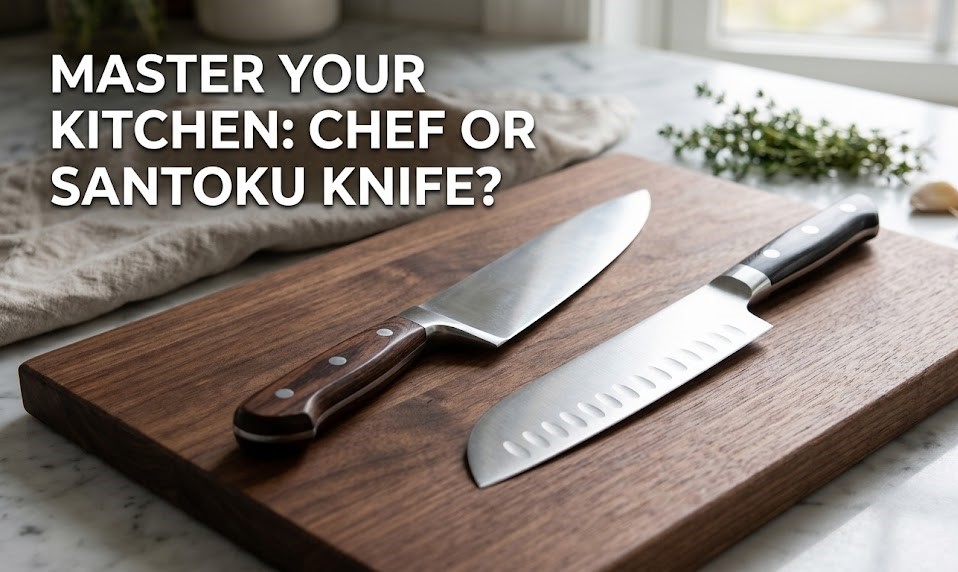
    When selecting between premium knife offerings for your kitchen, understanding their practical applications makes all the difference. While both blades are essential multi-purpose tools, they each bring distinct strengths to your cutting board.

    Consider your personal cooking style and typical ingredients when making your choice. The classic chef knife proves invaluable for larger tasks and heavy-duty chopping, while the Santoku shines in detailed prep work requiring exactness and finesse.
    Santoku vs. Chef’s Knife: What’s the Difference?

    Understanding Blade Designs

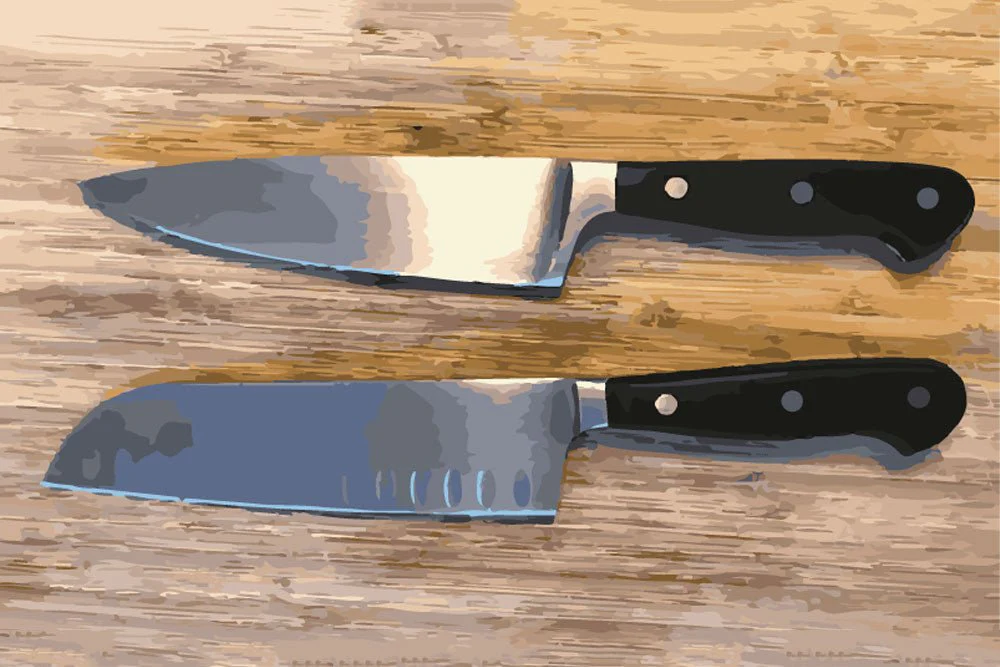
    The chef’s knife blade design showcases proven Western craftsmanship with its signature curved edge and longer blade length. It is perfectly suited for the characteristic “rocking motion” during cutting. Premium chef knives feature robust, full-tang construction and precision-honed edges that deliver exceptional performance for a wide range of heavy kitchen tasks, from dicing onions to breaking down whole poultry.

    The Santoku blade features a distinctive Japanese design with a shorter, straight cutting edge. Its wide, flat profile is beneficial for scooping up ingredients, while the precision-engineered edge ensures optimal cutting performance. Because the blade lacks a curved belly, its unique profile excels at rapid up-and-down cutting motions rather than rocking. Most Santoku blades also incorporate specialized grooves (a Granton edge) that prevent starchy or delicate food from sticking to the metal during use.

    Features of Santoku Knives: What Are Their Advantages?

    The name “santoku” translates to “three virtues,” representing its absolute mastery of three essential cutting techniques: slicing, dicing, and chopping.

    The Santoku knife represents Japanese precision engineering at its finest. Its balanced weight distribution and ergonomic design make it especially adept at precise cutting tasks, from creating paper-thin vegetable slices to portioning delicate fish fillets. The distinctive design features a shorter blade length, typically around 7 inches.

    Santoku knives excel at the following cutting techniques:

    • Push-cutting: For clean, highly precise vegetable slices.
    • Tap-chopping: For uniform dicing and rapid mincing.
    • Pull-slicing: For exceptionally thin, delicate cuts of fish and raw meat.
    • Vertical chopping: For finely processing herbs and aromatics.

    Features of Chef Knives: What Is a Chef Knife Used For?

    The chef’s knife stands as the quintessential kitchen tool, revered by professional chefs and home cooks alike for its exceptional, heavy-duty versatility. This iconic blade typically ranges from 6 to 12 inches in length, with the 8-inch version being the most popular for its optimal balance of power, weight, and control.

    The distinctive design features a broad heel that tapers to a pointed tip, creating a slight curve along the cutting edge known as the “belly.” This curved profile enables the characteristic rocking motion technique, where the knife pivots smoothly against the cutting board while maintaining constant contact. The wide, heavy blade serves multiple functions, from crushing whole cloves of garlic to scooping prepared ingredients.

    Chef knives excel at the following cutting techniques:

    • Rock chopping: For easily breaking down large piles of herbs and leafy vegetables.
    • Straight-down chopping: For firm, dense root vegetables like potatoes and carrots.
    • Draw cuts: For smoothly slicing through thicker meats and fish.
    • Cross-chopping: For heavy, fine mincing tasks.
    All-Clad Professional Knife Sets: The Best of Both Worlds

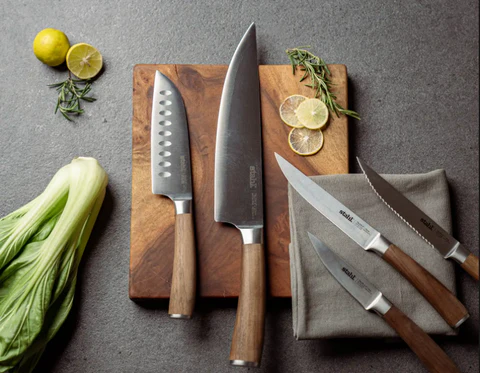
    If you can’t choose just one, comprehensive knife sets combine the versatility of both the chef knife and the Santoku knife into one professional collection.

    • The 7-Piece Set: Features an 8-inch chef’s knife and a 7-inch Santoku knife, allowing home cooks to experience the best of both Western and Asian cutting techniques. It also includes essentials like a serrated utility knife, paring knife, honing steel, and kitchen shears housed in an acacia wood block.
    • The 12-Piece Set: Builds upon the foundational 7-piece block by adding premium steak knives and a long 8-inch bread knife for a complete kitchen solution.

    Choosing the Right Knife for You

    When investing in a knife, material quality is paramount. Premium kitchen knives are often crafted from X50CrMoV15 German stainless steel. This exceptional material combines high chromium content with the perfect balance of manganese, silicon, and carbon, delivering superior rust resistance and lasting durability.

    Additionally, look for blades that undergo an innovative cryogenic treatment with liquid nitrogen, which massively enhances both edge retention and overall corrosion resistance. Whether you choose the precise 7-inch Santoku or the robust 8-inch Chef Knife, investing in a precision-engineered 26-degree total cutting edge will achieve the ideal balance between razor-sharp performance and chip resistance in your kitchen.
  • How to Sharpen Kitchen Knives Like a Pro

    How to Sharpen Kitchen Knives Like a Pro

    No matter what kind of meal you are preparing, chances are it involves using a knife to slice, chop, or dice ingredients. Considering we use them on a daily basis, it is vital to maintain your knives. Keeping them sharp and honed not only allows you to cut cleanly and with precision, but it actually keeps you safer!

    Contrary to popular belief, a sharp knife is much less likely to cause a cutting mishap than a dull blade, which is prone to slipping and juddering.

    Chef Ruth Hansom from Hansom Restaurant offers a great test: “Cutting a tomato is always a good indication. If you’re unable to cut through the skin without squashing the tomato, you have a blunt blade.”

    After you have invested in a quality kitchen knife set, it is time to choose a sharpening tool to keep them in perfect condition. Here is our cutting-edge guide to the best sharpening tools and techniques.

    1. Whetstones (Manual Sharpening)

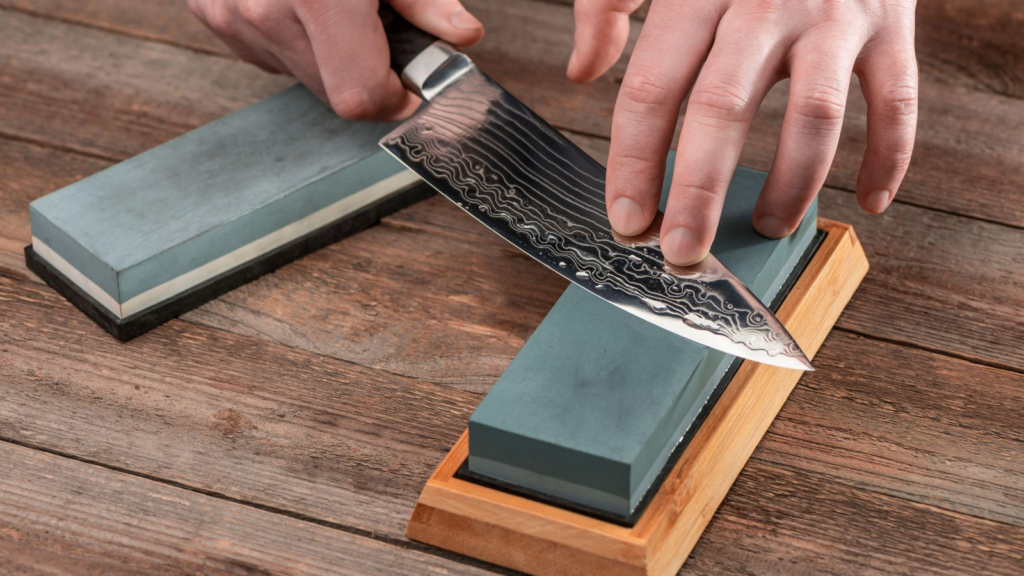
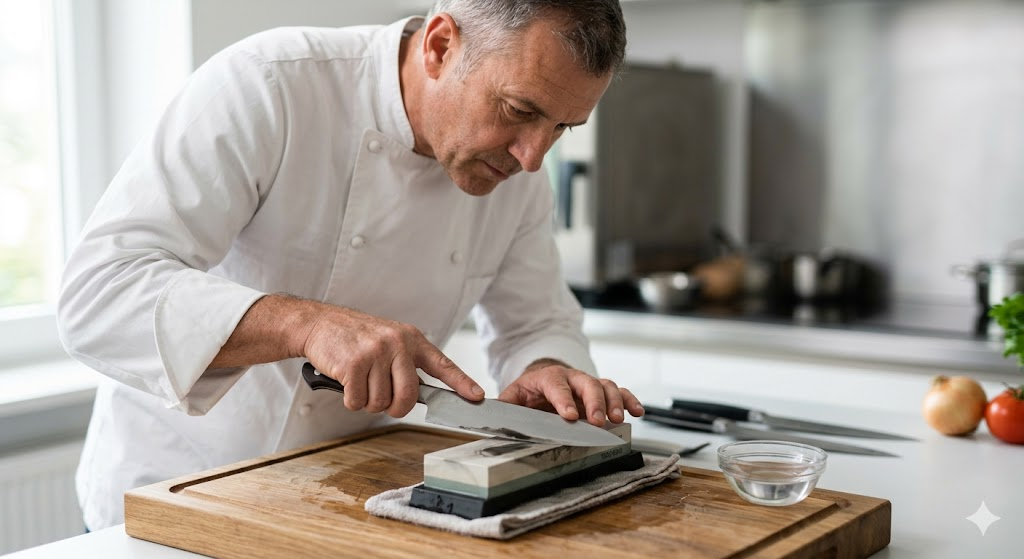
    Whetstones are the most traditional and precise way to keep blades sharp. These flat, rectangular blocks are used to sharpen a knife by rubbing the blade’s surface against the block to physically grind away microscopic amounts of metal, creating a brand new edge.

    Understanding Grit Size:

    • Coarse (400 grit): For repairing chips and incredibly dull knives.
    • Medium (1000 grit): The standard choice for regular sharpening.
    • Fine (4000–8000 grit): Used solely for polishing the edge to a mirror finish.

    How to Use a Whetstone:

    1. Submerge the stone in water for 10 minutes.
    2. Place it on a slip-resistant surface, coarse side up.
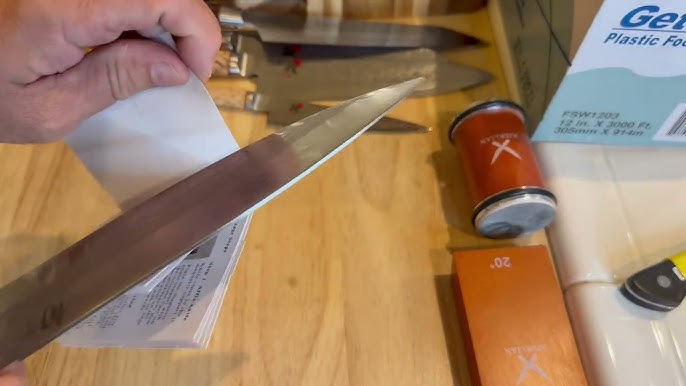
    3. Hold the knife at a 14-degree angle (or the angle recommended by the manufacturer).
    4. Slowly slide the blade across the stone from the tip to the heel.
    5. Repeat on the other side, then flip the stone to the fine side to polish.
    • Pros: Highly precise, cost-effective, space-saving.
    • Cons: Requires practice and patience to master the angle.

    2. Sharpening Rods (Honers)

    Professional chefs swear by using a honing rod daily. A honing rod does not actually sharpen a knife. Instead, it realigns the microscopic edge of the blade, which gets bent out of shape every time it hits your chopping board.

    How to Hone: Hold the rod firmly and place the blade against it at roughly a 20-degree angle. Draw the blade down and towards you smoothly, alternating sides. Doing this before every cooking session will significantly delay your need for an actual whetstone sharpening!

    • Pros: Protects the blade, budget-friendly, highly effective for daily maintenance.
    • Cons: Cannot fix a truly dull or chipped knife.

    3. Electric Knife Sharpeners

    If you are not confident holding an exact 14-degree angle on a whetstone, an electric sharpener is your best friend. These machines feature internal motorized abrasive wheels or belts. You simply pull the blade slowly through the designated slots, and the machine does the precise grinding for you.

    • Pros: Incredibly easy, quick, and provides a highly consistent angle.
    • Cons: Expensive, bulky to store, and can grind away too much metal if overused, which decreases the lifespan of your knife.

    4. Pull-Through Sharpeners

    Pull-through manual sharpeners are the most popular option for casual home cooks. They feature V-shaped ceramic, stone, or diamond wheels set into a plastic handle. You simply pull the blade through the slots a few times to re-establish the edge.

    • Pros: Budget-friendly, easy to use, great for quick fixes.
    • Cons: Not suitable for brittle or thin Japanese blades, as the aggressive grinding can cause chipping.

    Expert Maintenance Tips

    Once you have your knives dangerously sharp, how do you keep them that way?

    • Never Use the Dishwasher: “The single most important thing to remember is never to put a knife in the dishwasher,” warns Laurie Timpson of Savernake Knives. The salty detergents and 80ºC heat will destroy both the steel and the handle. Always wash by hand and dry immediately.
    • Check Your Chopping Board: Never cut on hard surfaces like glass, marble, or granite. Always use a soft end-grain wood or plastic cutting board to protect the blade’s edge.
    • Store Properly: Do not throw your knives into a messy utensil drawer where they will bang against other metal tools. Store them safely in a block, on a magnetic strip, or inside protective sheaths.

    Whether you opt for the meditative precision of a whetstone or the quick convenience of an electric sharpener, regular maintenance is the key to effortless cooking!