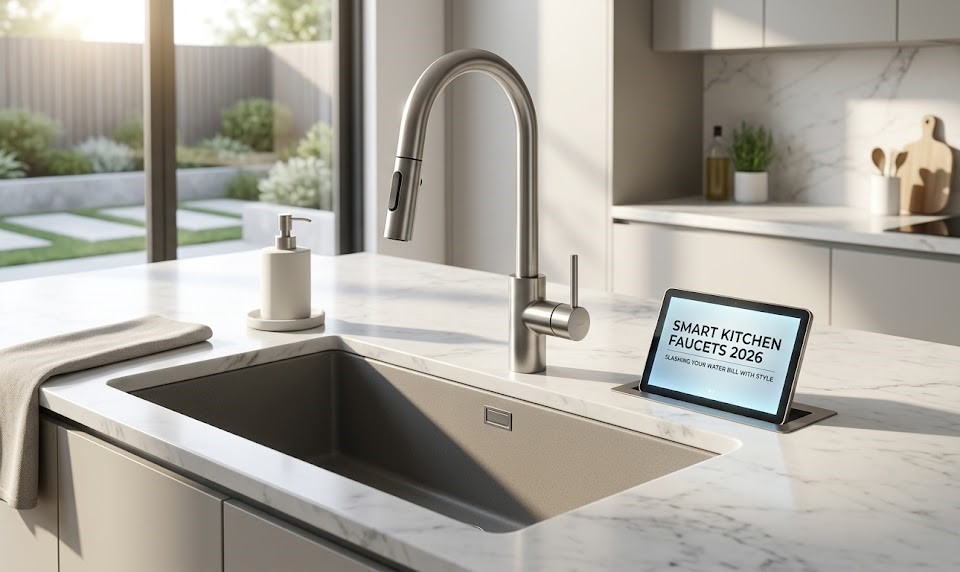
If your kitchen sink is secretly draining your budget faster than your streaming subscriptions, you aren’t alone. Most homeowners don’t realize the average faucet is accessed dozens of times a day, leading to a massive cumulative waste through “ghost flows”—those extra seconds the water runs while you reach for a towel or scrub a stubborn pan.
In late March 2026, the smart kitchen has moved beyond simple “voice-activated gimmicks” into the realm of Precision Resource Management. Upgrading to a smart faucet is no longer just about feeling like you’re on the bridge of a starship; it’s a strategic metabolic fix for your home’s utility efficiency.
The Tech: Beyond the Motion Sensor
The 2026 generation of faucets has finally solved the “accidental activation” problem that plagued early touchless models.
- Infrared & Ultrasonic Fusion: Leading models now use dual-sensor arrays to distinguish between a hand reaching for a sponge and a cat walking across the counter.
- Matter 1.4 Integration: Your faucet now talks to your home hub. If your Matter-certified smart home system detects you’ve left the house but the kitchen flow is still active, it can trigger an emergency remote shutoff.
- Timed Metering: Many high-end models from Moen and Kohler now feature “Fractional Dispensing,” allowing you to ask for exactly $250\text{ml}$ of water, eliminating the waste of overfilling.
The Math: Calculating Your Water ROI
How much can you actually save? The difference between an older 2.2 Gallons Per Minute ($GPM$) faucet and a modern EPA WaterSense certified smart model is staggering when calculated over a year.
The formula for daily consumption ($D$) based on $n$ uses per day and $t$ time in minutes is:
$$D = n \times t \times GPM$$
If a standard family reduces their average run-time from $30\text{s}$ down to $10\text{s}$ per use (thanks to touchless shutoff) and drops the flow from $2.2\text{ GPM}$ to $1.5\text{ GPM}$:
- Old System: $30 \text{ uses} \times 0.5\text{ min} \times 2.2\text{ GPM} = 33\text{ gallons/day}$
- Smart System: $30 \text{ uses} \times 0.17\text{ min} \times 1.5\text{ GPM} = 7.6\text{ gallons/day}$
That is a $77\%$ reduction in daily water waste. According to the EPA WaterSense program guidelines, switching to high-efficiency fixtures can save the average household over $700\text{ gallons}$ of water per year—the equivalent of $40$ showers.
2026 Top Picks: A Comparative Analysis
| Model | Key Tech | Best For | Flow Rate |
| Moen Smart Faucet | Motion Control & Voice | The Tech-Obsessed Cook | $1.5\text{ GPM}$ |
| Kohler Sensate | Precision Induction | Minimalist Aesthetics | $1.5\text{ GPM}$ |
| Delta Touch2O | Capacitive Touch | Budget-Conscious Savers | $1.8\text{ GPM}$ |
| GROHE Minta | Pull-down SmartControl | Serious Home Chefs | $1.2\text{ GPM}$ |
For a deep dive into how these models hold up under 2026’s rigorous durability tests, check out the Consumer Reports Guide to Kitchen Faucets.
The Quiet Hero: Integrated Leak Detection
While touchless sensors save water during active use, Leak Detection saves water during silence. A micro-leak of just $0.25\text{ gallons/hour}$—barely a drip—wastes over $2,000\text{ gallons}$ a year.
Current 2026 models like the Moen U or Kohler Konnect feature internal pressure sensors that monitor for “micro-pulses.” If the pressure drops while the valves are supposedly closed, the app sends a notification directly to your phone. As noted by Home Innovation Research Labs, smart plumbing is the #1 way to prevent catastrophic secondary water damage in modern homes.
Conclusion
Smart faucets in 2026 are the perfect intersection of luxury and responsibility. By transitioning from a manual “always-on” habit to a sensor-driven “on-demand” system, you are taking a massive leap toward household sustainability without sacrificing the convenience of a high-end kitchen. Whether you’re trying to prevent the spread of raw chicken germs or just trying to lower your monthly utility bill, the smart faucet is an investment that pays for itself in both gallons and peace of mind.
Also Read : Air Fryer vs. Convection Oven: The 2026 Nutritional Resilience Guide