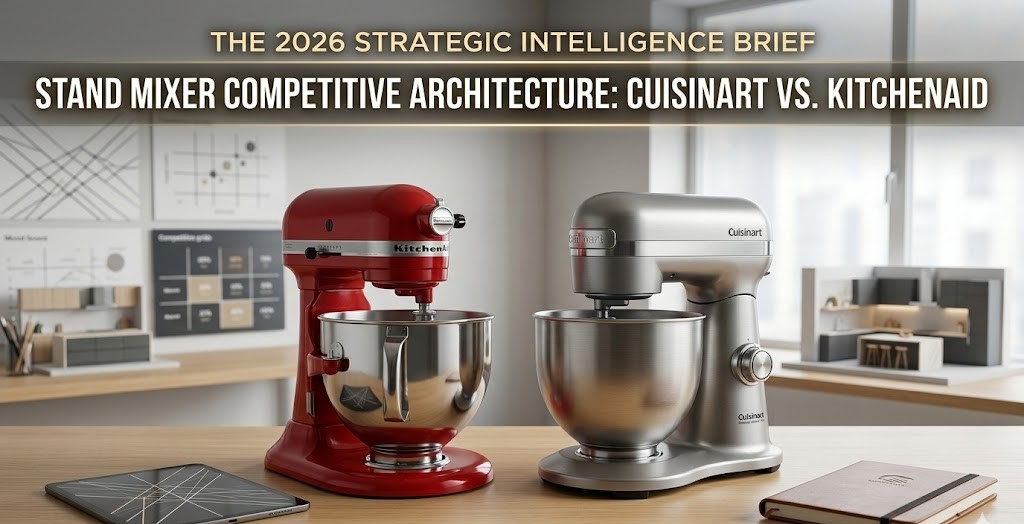
In the consumer appliance sector of 2026, the stand mixer remains a high-value anchor point for domestic and semi-professional kitchens. The market is functionally a duopoly dominated by Cuisinart and KitchenAid. Choosing between these two brands requires a strategic analysis of mechanical engineering, motor torque efficiency, aesthetic design, and capital investment. This intelligence brief deconstructs the competitive advantages, structural limitations, and microeconomic positioning of both culinary hardware platforms.
1. Historical Context and Foundational Architecture
The stand mixer is a foundational piece of kitchen engineering, designed to mechanize the labor-intensive tasks of whipping, beating, and Kneading. KitchenAid (owned by Whirlpool Corporation) is the legacy incumbent, having introduced its iconic Model “H” in 1919. Its design philosophy is rooted in heavy, generational-use cast metal and “direct-drive” transmission. Cuisinart, operating under Conair Corporation, entered the stand mixer market much later, bringing a distinct philosophy of modern precision, lighter-weight chassis design, and digital integration (such as built-in timers), appealing to a more pragmatic, budget-conscious demographic.
2. Technical Mechanics and Motor Architecture
The structural mechanics and motor power of these two brands present the most critical point of divergence.
- Cuisinart Mechanics: Cuisinart models frequently utilize a standard belt-driven or indirect transmission system but compensate with high raw wattage. Their motors typically range from 500 to 1,000 watts. This high wattage allows them to maintain consistent speed under load. Furthermore, Cuisinart’s integration of digital timer functions allows for precise, unattended mixing intervals.
- KitchenAid Mechanics: KitchenAid utilizes a Direct-drive mechanism (specifically in their bowl-lift and premium tilt-head models). While their wattage appears lower on paper—ranging from 250 Watts in the Classic Series to 970 Watts in the Professional Series—the direct-drive transmission channels kinetic energy far more efficiently from the motor to the beater. This allows a 325-watt KitchenAid to generate equivalent or superior torque compared to a higher-wattage, indirect-drive competitor when facing dense bread doughs.
3. Economic Impact and Capital Expenditure (CAPEX)
From a microeconomic perspective, the acquisition of a stand mixer is a significant Capital Expenditure (CAPEX) for the home baker.
- The Cuisinart Economy: Cuisinart operates on a “Value-Maximized” pricing strategy. They offer high-wattage motors, large bowl capacities (5.5 to 7.0 Quarts), and robust performance at a significantly lower initial price point than KitchenAid. This makes Cuisinart the optimal economic choice for consumers requiring high-capacity baking capability without a luxury budget.
- The KitchenAid Economy: KitchenAid demands a premium initial CAPEX. However, this is rationalized as a long-term investment. The heavy cast-zinc construction and repairable internal gear systems ensure a lifespan measured in decades. Furthermore, the universal “Power Hub” interface at the front of the mixer—which remains compatible with attachments dating back to the 1930s—protects the consumer’s investment in accessories (meat grinders, pasta rollers) even if the base unit is upgraded.
4. Sociocultural and Behavioral Implications
Socioculturally, the stand mixer has evolved from a pure utility tool into a high-visibility kitchen status symbol. KitchenAid dominates this behavioral sphere. The brand’s decision to offer dozens of custom colors and limited-edition finishes transforms the appliance into a central element of interior design. It signals domestic proficiency and artisanal aspiration. Cuisinart, while sleek and modern, is typically viewed through a pragmatic lens; it is selected for its functional utility and space-saving, lightweight footprint rather than its aesthetic prestige.
5. Regulatory, Ethical, and Ecological Frameworks
Both brands must adhere to stringent manufacturing and safety regulations, particularly concerning food-contact surfaces. The primary ecological distinction lies in their manufacturing lifecycles. KitchenAid’s heavy reliance on cast metal and repairable, mechanical gearboxes aligns with “Right to Repair” ethics and reduces electronic waste, as the machines can frequently be rebuilt rather than replaced. Cuisinart models, while durable, utilize more lightweight composites and integrated digital boards, which can complicate long-term repairability if electronic components fail, potentially accelerating their path to e-waste.
6. Competitive Analysis and Strategic Positioning
In the 2026 market matrix, the brands are positioned to capture distinct consumer profiles:
- Cuisinart: Positioned for the pragmatist. It wins on high capacity (often boasting larger standard bowls than entry-level KitchenAids), modern features (digital timers), lighter weight for easy storage, and immediate cost-efficiency.
- KitchenAid: Positioned for the traditionalist and semi-professional. It wins on unyielding durability, efficient direct-drive torque for heavy doughs, an unparalleled, universally compatible attachment ecosystem, and premium aesthetic status.
7. Predictive Modeling: The Future of the Stand Mixer (2026–2030)
Looking toward 2030, predictive models indicate a convergence of these two distinct philosophies driven by smart technology. We anticipate future KitchenAid models will be forced to adopt the digital conveniences pioneered by brands like Cuisinart, such as integrated load cells (built-in scales) and automatic shut-off timers. Conversely, Cuisinart will likely need to adopt more efficient, direct-drive brushless DC motors to reduce raw wattage draw while maintaining high torque. Ultimately, the market will demand appliances that combine the generational durability of a KitchenAid with the digital precision of a Cuisinart.